Kayseri'de e-fatura firması mı arıyorsunuz? Entegrasyon, kontör fiyatları, mali müşavir uyumu ve destek hizmetlerini...

Sepet
Latest posts
-
 Kayseri'de E-Fatura Firması Seçerken Nelere Dikkat Edilmeli? (2026 Rehberi)Daha Fazla
 -
 How NetwoTurk Builds Digital Solutions for E-Commerce BusinessesDaha Fazla
Discover how NetwoTurk approaches PrestaShop development, custom modules, e-commerce integrations, marketplace...
-
 Selling Online in Turkey: E-Commerce, Marketplaces and Localization Guide for International Brands (2026)Daha Fazla
Turkey has become a significant e-commerce market for international brands looking to expand into a large, digitally...
-
 E-Ticaret Sitem Var Ama Satış Yok: Satış Yapmamasının 12 Nedeni ve ÇözümleriDaha Fazla
E-ticaret sitesinin satış yapmaması her zaman sitenin kötü olduğu anlamına gelmez. Sorun trafik, hedefleme, ürün,...
-
 E-Ticaret Danışmanlığı Nedir? İşletmeler Neden Profesyonel E-Ticaret Danışmanlığı Almalı? 2026 RehberiDaha Fazla
E-ticaret sitesi kurmak artık geçmişe göre çok daha kolay. Bir alan adı satın almak, hazır bir altyapı seçmek,...
-
 Influencer Marketing in Turkey: A Practical Guide for International Brands in 2026Daha Fazla
Turkey offers international brands a digitally active, mobile-first audience and a creator ecosystem capable of...
-
 Trendyol'da Satışlar Neden DüşerDaha Fazla
Trendyol satışlarınız neden düştü? Mağaza puanı, Buybox, ürün görünürlüğü, reklam, stok ve iade sorunlarını...
-
 PrestaShop 500 Internal Server Error Hatası Nasıl ÇözülürDaha Fazla
PrestaShop 500 Internal Server Error neden olur? PHP, modül, tema, override, hosting ve güncelleme kaynaklı 500...
-
 PrestaShop Uzmanı Ne Yapar? PrestaShop Destek, Kurulum ve Geliştirme Rehberi 2026Daha Fazla
PrestaShop uzmanı mı arıyorsunuz? PrestaShop teknik destek, hata çözümü, hızlandırma, modül ve tema geliştirme, SEO,...
-
 Yapay Zeka İle Web Sitesi Güvenli Mi?Daha Fazla
Yapay zekâ ile yapılan web siteleri güvenli mi? Riskleri, doğru güvenlik yaklaşımını ve NetwoTürk'ün insan denetimli...
Blog categories
Search in blog
Archived posts
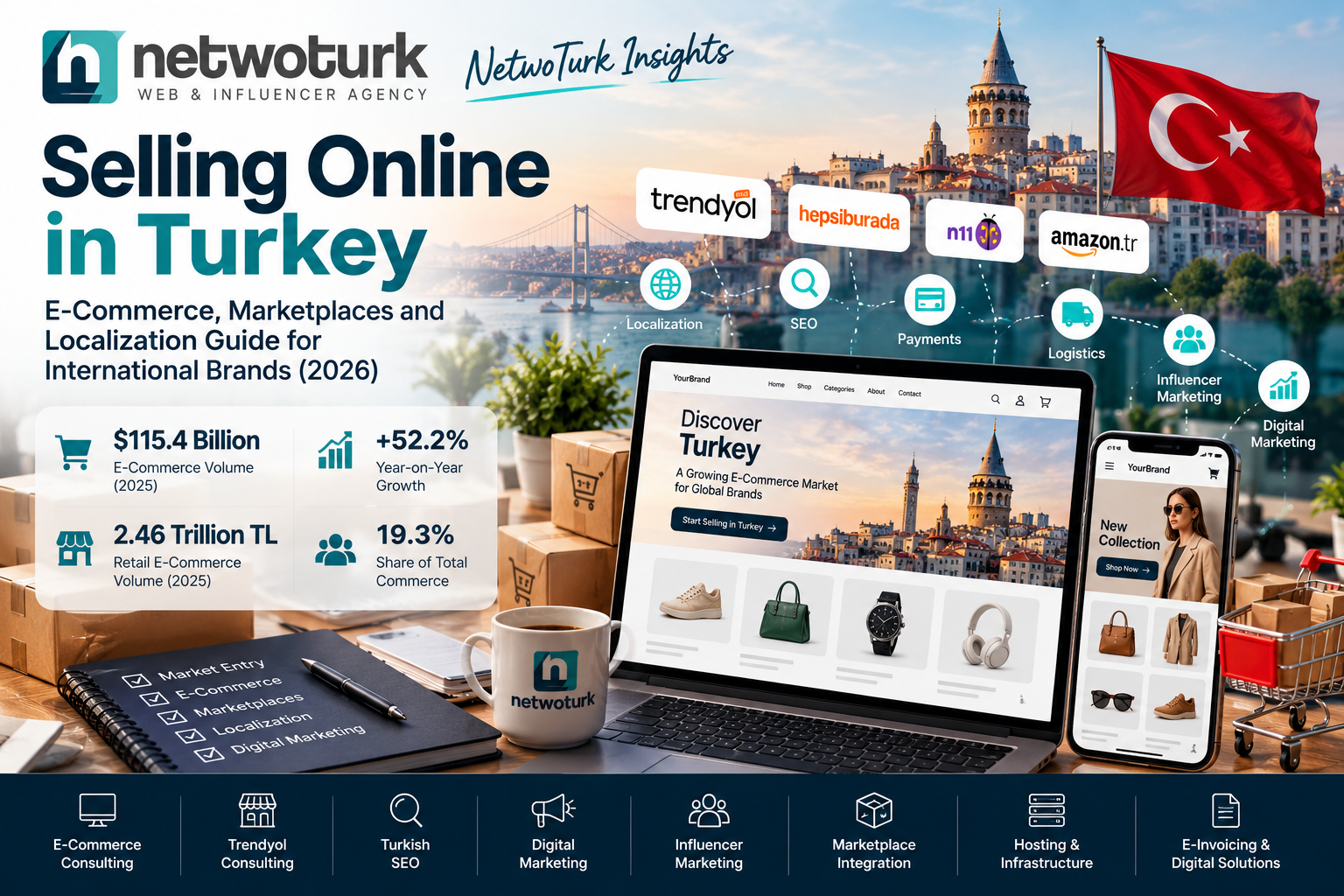
Selling Online in Turkey: E-Commerce, Marketplaces and Localization Guide for International Brands (2026)
Successful market entry requires a localized strategy covering e-commerce infrastructure, marketplaces, Turkish SEO, payment expectations, logistics, digital marketing, influencer marketing, customer experience and local regulations.
For international companies asking:
“How can I sell online in Turkey?”
the better question is:
How should we build a sustainable digital sales operation for the Turkish market?
This guide explains the key areas international brands should evaluate before entering Turkey's e-commerce market.
How Large Is the E-Commerce Market in Turkey?
Turkey's e-commerce market continued to grow strongly in 2025.
According to the Republic of Türkiye Ministry of Trade's E-Commerce Outlook in Türkiye 2025 report, total e-commerce volume exceeded TRY 4.5 trillion in 2025, representing a 52.2% year-on-year increase.
In US dollar terms, e-commerce volume reached approximately USD 115.43 billion.
Retail e-commerce alone reached TRY 2.46 trillion, while approximately 634,611 businesses were engaged in e-commerce activities across Turkey.
E-commerce represented 19.3% of overall commerce in 2025.
These figures demonstrate that e-commerce is no longer a secondary sales channel in Turkey. It is a major component of the country's commercial ecosystem.
For international brands, however, market size alone does not guarantee success.
The way Turkish consumers search, compare, pay for and purchase products needs to be understood locally.
Is Turkey a Good Market for International E-Commerce Brands?
Turkey can offer significant opportunities, but the potential varies considerably by industry, product, pricing and market-entry model.
According to official 2025 data, clothing, footwear and accessories represented the largest e-commerce sector by transaction value, reaching TRY 428.7 billion.
Electronics followed with approximately TRY 304.34 billion.
This does not mean that every fashion or electronics company will automatically succeed in Turkey.
Before entering the market, brands should evaluate:
-
Existing local competition
-
Product-market fit
-
Turkish consumer expectations
-
Pricing
-
Import and operational costs
-
Marketplace competition
-
Local search demand
-
Logistics
-
Returns
-
Payment infrastructure
-
Brand awareness
A market-entry decision should therefore be based on research rather than population size alone.
What Is the Best Way to Sell Online in Turkey?
There is no single model that works for every international company.
A brand may enter Turkey through:
-
Its own localized e-commerce website
-
Turkish marketplaces
-
A combination of marketplace and direct-to-consumer sales
-
Local distribution or commercial partnerships
-
Social commerce and digital acquisition channels
For many businesses, a hybrid strategy can be worth evaluating.
Marketplaces can provide access to existing consumer demand, while an owned e-commerce website gives the brand greater control over its identity, customer experience, SEO and long-term digital presence.
The right model depends on the company's objectives and operational capabilities.
Marketplace or Your Own E-Commerce Website?
This is one of the most important decisions international brands face when entering Turkey.
The two channels should not necessarily be viewed as alternatives.
They can serve different purposes.
Selling Through Marketplaces
Marketplaces provide access to consumers who already have purchase intent.
Potential advantages include:
-
Existing consumer traffic
-
Established marketplace trust
-
Faster product discovery
-
Existing promotional ecosystems
-
Familiar shopping experiences
However, brands also need to consider:
-
Marketplace commissions
-
Price competition
-
Marketplace rules
-
Seller performance requirements
-
Advertising costs
-
Limited ownership of the customer relationship
For these reasons, marketplace revenue should not be evaluated solely by gross sales.
Profitability matters.
Selling Through Your Own Website
An owned e-commerce website provides more control over:
-
Brand positioning
-
User experience
-
Product presentation
-
Content
-
SEO
-
Campaigns
-
Customer journey
-
Analytics
-
First-party customer relationships
But having a website does not automatically generate customers.
The brand must build traffic through channels such as SEO, Google Ads, social media, content marketing and influencer marketing.
For many international brands, the stronger long-term strategy can therefore involve both marketplace presence and an owned Turkish e-commerce channel.
Selling on Trendyol in Turkey
For companies researching the Turkish e-commerce ecosystem, marketplace strategy is an important part of market-entry planning.
A marketplace operation should not simply consist of uploading products.
Brands need to consider:
-
Product titles
-
Categories
-
Product attributes
-
Product images
-
Pricing
-
Inventory
-
Seller performance
-
Shipping
-
Returns
-
Campaigns
-
Advertising
-
Customer questions
-
Profitability
Price competition can become particularly important when multiple sellers offer identical or similar products.
International brands should therefore calculate the complete economics of marketplace sales before aggressively pursuing volume.
The important question is not only:
How much can we sell?
It is also:
How profitably can we sell?
Localization Is More Than Translation
One of the most common mistakes international brands make is treating localization as a translation project.
A website can be perfectly translated into Turkish and still fail to connect with Turkish consumers.
Localization can involve:
-
Language
-
Currency
-
Product terminology
-
Measurements
-
Pricing presentation
-
Payment expectations
-
Delivery information
-
Customer support
-
Returns
-
Promotions
-
Search behavior
-
Cultural context
Product names are a simple example.
The literal translation of an English product name may not match the terminology Turkish consumers actually use when searching online.
That difference can affect both SEO and conversion.
Turkish Content Should Sound Native
Machine translation can accelerate the localization process, but important commercial pages should be reviewed for natural Turkish usage.
This is especially important for:
-
Category pages
-
Product pages
-
Advertisements
-
Landing pages
-
SEO content
-
Customer support
-
Legal and commercial information
The objective is not simply grammatical correctness.
The content needs to make sense to the local customer.
SEO in Turkey Requires a Turkish Search Strategy
International brands sometimes translate their existing SEO keywords directly into Turkish.
This approach can produce weak results.
Search behavior varies between markets.
The English keyword that performs well in another country may not have an equivalent search pattern in Turkey.
A Turkish SEO strategy should therefore include local keyword research.
Important areas include:
-
Turkish keyword research
-
Competitor analysis
-
Search intent
-
Category architecture
-
Product naming
-
Metadata
-
Internal linking
-
Technical SEO
-
Site performance
-
Structured data
-
Local content
-
Blog strategy
International brands should also distinguish between informational and commercial searches.
A user searching for information about a product is at a different stage of the customer journey from someone searching for where to buy it.
Both can be valuable, but they require different content.
Why Google Turkey Visibility Matters
Marketplaces are powerful discovery channels, but brands should not become dependent on a single platform.
Google visibility helps build an independent source of customer acquisition.
For example, Turkish consumers may search for:
-
Product categories
-
Product comparisons
-
Brand reviews
-
How-to information
-
Problems solved by a product
-
Product specifications
-
Local suppliers
-
Where to buy specific products
A structured Turkish SEO and content strategy can allow the brand to appear throughout this research process.
Over time, this can strengthen both sales and brand awareness.
Payment Behavior in Turkish E-Commerce
Payment localization is another important part of the customer experience.
According to Türkiye's Ministry of Trade, card payments represented 62.5% of e-commerce payment volume in 2025.
Bank transfer/EFT accounted for 29.2%, while cash on delivery represented 3.5%.
Among card payments, 64.1% used 3D Secure.
These figures demonstrate the importance of building payment experiences appropriate to the Turkish market.
Payment strategy should be evaluated together with:
-
Local payment infrastructure
-
Security
-
Mobile checkout
-
Installment expectations where applicable
-
Refund processes
-
Checkout usability
A customer who wants to buy but cannot complete payment is not a marketing problem.
It is a conversion problem.
Mobile Experience Matters
Turkish consumers frequently interact with brands through mobile devices and social platforms.
For that reason, international brands entering Turkey should not treat mobile optimization as an optional final step.
The entire purchasing journey should be tested on mobile:
-
Homepage
-
Navigation
-
Search
-
Category pages
-
Product pages
-
Cart
-
Checkout
-
Payment
-
Customer account
-
Support
A visually impressive desktop website can still underperform if purchasing from a smartphone is difficult.
Website Speed Can Directly Affect Commercial Performance
Localization is irrelevant if the website is frustratingly slow.
International companies sometimes serve Turkish customers from infrastructure designed primarily for another geographic market.
Depending on the architecture, this can contribute to performance issues.
Website performance should therefore be assessed technically.
Potential areas include:
-
Hosting
-
Server resources
-
Database performance
-
Caching
-
Image optimization
-
Theme performance
-
Third-party scripts
-
E-commerce modules
-
CDN configuration
The objective should not simply be achieving a particular test score.
The objective is creating a fast and stable shopping experience for real users.
Choosing an E-Commerce Platform for Turkey
International brands have several infrastructure options.
Depending on requirements, these may include open-source platforms, SaaS systems or custom solutions.
NetwoTurk works with e-commerce technologies including PrestaShop and WordPress/WooCommerce, as well as consulting and implementation around other e-commerce environments.
The technology decision should consider:
-
Number of products
-
Expected traffic
-
Integration requirements
-
Marketplace strategy
-
ERP requirements
-
Localization
-
SEO
-
Scalability
-
Custom development requirements
-
Internal technical resources
-
Budget
The most popular platform is not automatically the best platform for every company.
Technology should follow the business model, not the other way around.
PrestaShop for the Turkish Market
PrestaShop can be particularly relevant for brands requiring greater control over their e-commerce infrastructure and custom development.
Depending on the project, it can support:
-
Custom themes
-
Custom modules
-
Payment integrations
-
Logistics integrations
-
ERP connections
-
E-invoicing workflows
-
Marketplace integrations
-
Multilingual stores
-
SEO customization
However, open-source flexibility also means technical management becomes important.
Hosting, security, updates, modules, themes and custom code need to be managed as a complete system.
E-Invoicing and Digital Transformation
International brands entering Turkey should also understand that the transaction does not end when the customer completes checkout.
Order, invoicing, accounting and operational processes need to work together.
Depending on the company's legal structure, activity and applicable Turkish requirements, solutions related to electronic invoicing and other digital transformation processes may need to be considered.
These requirements should be assessed with appropriate financial and legal professionals for the specific business.
From a technology perspective, the e-commerce architecture should be planned so that relevant invoicing, ERP, accounting and order systems can communicate where required.
Inventory and Marketplace Integration
Operating an e-commerce website and multiple marketplaces creates another challenge:
Inventory.
If systems operate independently, the same product can potentially be sold on multiple channels after physical inventory has already been depleted.
This can lead to:
-
Order cancellations
-
Customer dissatisfaction
-
Operational errors
-
Marketplace performance problems
Depending on the operation, integrations can help synchronize:
-
Inventory
-
Orders
-
Products
-
Prices
-
Invoices
-
Shipping information
Automation should not be implemented simply because it is technically possible.
It should solve a measurable operational problem.
Digital Marketing in Turkey
A localized e-commerce operation also requires localized customer acquisition.
Possible channels include:
-
Google Ads
-
SEO
-
Social media
-
Influencer marketing
-
Marketplace advertising
-
Content marketing
-
Remarketing
The right mix depends on the product and target customer.
A B2B technology company should not necessarily use the same strategy as a fashion brand.
Likewise, a brand entering Turkey for the first time may need to balance immediate customer acquisition with long-term brand building.
Influencer Marketing in Turkey
Influencer marketing can play an important role in introducing international products to Turkish consumers.
But influencer selection should not be based only on follower count.
Brands should evaluate factors such as:
-
Audience relevance
-
Content category
-
Engagement
-
Geography
-
Brand fit
-
Content quality
-
Campaign objectives
-
Reporting
A smaller creator whose audience closely matches the product can sometimes be more valuable than a larger account with weak audience relevance.
International brands should therefore approach influencer marketing as a measurable marketing channel rather than simply purchasing social media exposure.
AI and E-Commerce Localization
Artificial intelligence is changing how brands approach international expansion.
AI can support areas such as:
-
Translation
-
Product descriptions
-
Content ideation
-
Customer service
-
SEO research
-
Advertising creatives
-
Data analysis
-
Product categorization
However, AI-generated content still requires local review.
This is especially important when dealing with:
-
Product claims
-
Legal information
-
Pricing
-
Technical specifications
-
Cultural context
-
Turkish search terminology
AI can accelerate localization.
It should not replace local market understanding.
Common Mistakes International Brands Make When Entering Turkey
Several mistakes repeatedly weaken international market-entry projects.
1. Simply Translating the Existing Website
Translation does not automatically create localization.
2. Entering Marketplaces Without Calculating Profitability
High sales volume can hide weak margins.
3. Ignoring Turkish SEO
A translated site cannot generate organic traffic if it does not match local search behavior.
4. Treating Turkey as Identical to Another Market
Consumer behavior, competition and commercial expectations vary by country.
5. Focusing Only on Customer Acquisition
Getting the first order is only one part of the operation.
Shipping, returns, support and retention also matter.
6. Using Disconnected Systems
Independent inventory, marketplace, website and invoicing systems can create operational complexity as sales grow.
7. Selecting Influencers Only by Follower Count
Audience fit and campaign relevance are often more important.
8. Building Technology Before Building the Strategy
The website should support the commercial model, not define it.
A Practical Turkey Market Entry Framework
International brands can approach digital expansion into Turkey through a structured process.
Step 1: Market Research
Analyze product demand, competitors, pricing and consumer behavior.
Step 2: Commercial Model
Determine whether the brand will use marketplaces, its own website or a hybrid strategy.
Step 3: Localization
Adapt language, product positioning, customer experience and content.
Step 4: Technical Infrastructure
Select the appropriate e-commerce platform, hosting and integrations.
Step 5: Payments and Operations
Plan payment, logistics, inventory, invoicing and customer service workflows.
Step 6: SEO
Research Turkish search behavior and build the site's architecture accordingly.
Step 7: Customer Acquisition
Launch appropriate advertising, content, social and influencer strategies.
Step 8: Measurement
Track traffic, conversion, customer acquisition cost, profitability and operational performance.
Step 9: Optimization
Use real Turkish market data to improve the strategy continuously.
Why Work With a Local Digital Partner in Turkey?
International expansion involves a combination of technology, marketing and local market knowledge.
Working separately with a web developer, SEO agency, marketplace consultant, hosting company and influencer agency can make coordination difficult.
A local digital partner can help connect these disciplines around a single market-entry strategy.
The partner should understand not only how to build a website, but also how that website fits into the company's broader commercial operation.
NetwoTurk: Digital Market Entry Support for International Brands
NetwoTurk is a Turkey-based web, e-commerce and digital agency supporting businesses across multiple areas of digital commerce.
For international brands planning to enter or expand in the Turkish market, our services can include:
-
Turkey e-commerce consulting
-
E-commerce website development
-
PrestaShop development and technical support
-
WordPress and WooCommerce solutions
-
Marketplace consulting
-
Trendyol consulting
-
Turkish SEO strategy
-
Google Ads
-
Hosting and server solutions
-
API and system integrations
-
E-commerce automation
-
E-invoicing and digital transformation solutions
-
Influencer marketing
-
Turkish market digital strategy
Rather than automatically recommending a specific platform or marketing channel, we start by understanding the brand's objectives, existing infrastructure and Turkish market requirements.
The objective is to create a digital operation that can grow with the business.
Frequently Asked Questions About Selling Online in Turkey
Can a foreign company sell online in Turkey?
The appropriate structure depends on how the company plans to operate, invoice, import, distribute and sell products in Turkey. Legal, tax, customs and commercial requirements should be reviewed with qualified local professionals before launch.
From the digital side, the e-commerce infrastructure should be designed around the selected commercial model.
Should international brands use marketplaces in Turkey?
Marketplaces can be an important customer acquisition and sales channel. However, marketplace strategy should be evaluated alongside profitability, brand positioning and the company's long-term direct-to-consumer strategy.
Do I need a Turkish-language website?
For consumer-focused sales in Turkey, a professionally localized Turkish experience can be extremely important. Translation alone is not enough; search behavior, terminology and customer expectations should also be localized.
Is SEO different in Turkey?
The fundamental principles of SEO remain similar, but keywords, competition, language and search behavior differ. Turkish keyword research should therefore be conducted independently rather than simply translating an existing English keyword list.
What payment methods are popular in Turkish e-commerce?
Official 2025 Ministry of Trade data shows that card payments accounted for 62.5% of e-commerce payment volume, followed by bank transfer/EFT at 29.2%. Payment implementation should nevertheless be designed around the company's specific commercial and regulatory structure.
Can an international brand sell through both Trendyol and its own website?
A multi-channel model can be considered. The marketplace and owned website can serve different strategic roles, provided inventory, pricing, operations and profitability are managed correctly.
Can NetwoTurk help international companies enter the Turkish digital market?
Yes. NetwoTurk can support the digital side of market entry across e-commerce consulting, website development, marketplaces, SEO, hosting, integrations, digital marketing and influencer marketing.
Final Thoughts
Turkey should not be approached as simply another country where an existing e-commerce website is translated and switched on.
It is a substantial digital market with its own search behavior, marketplace ecosystem, payment patterns, competitive environment and consumer expectations.
The strongest market-entry strategy connects:
Market Research + Localization + E-Commerce + Marketplaces + SEO + Technology + Operations + Digital Marketing
into a single system.
For international brands, the objective should not simply be to start selling in Turkey.
The objective should be to build a Turkish digital sales operation that can become sustainable, measurable and scalable.
NetwoTurk supports international brands looking to understand, enter and grow in the Turkish digital market.
Phone: +90 850 308 18 25
Website: netwoturk.com
Behzat Boğazlıyanlıoğlu
Founder of NetwoTurk | E-Commerce & Digital Transformation Specialist
Posted in:
NetwoTurk Insights
Related posts
-
Influencer Marketing in Turkey: A Practical Guide for International Brands in 2026
Turkey offers international brands a digitally active, mobile-first audience and a creator ecosystem capable of...Daha Fazla
Leave a comment