Kayseri'de e-fatura firması mı arıyorsunuz? Entegrasyon, kontör fiyatları, mali müşavir uyumu ve destek hizmetlerini...
Sepet
Latest posts
-
 Kayseri'de E-Fatura Firması Seçerken Nelere Dikkat Edilmeli? (2026 Rehberi)Daha Fazla
 -
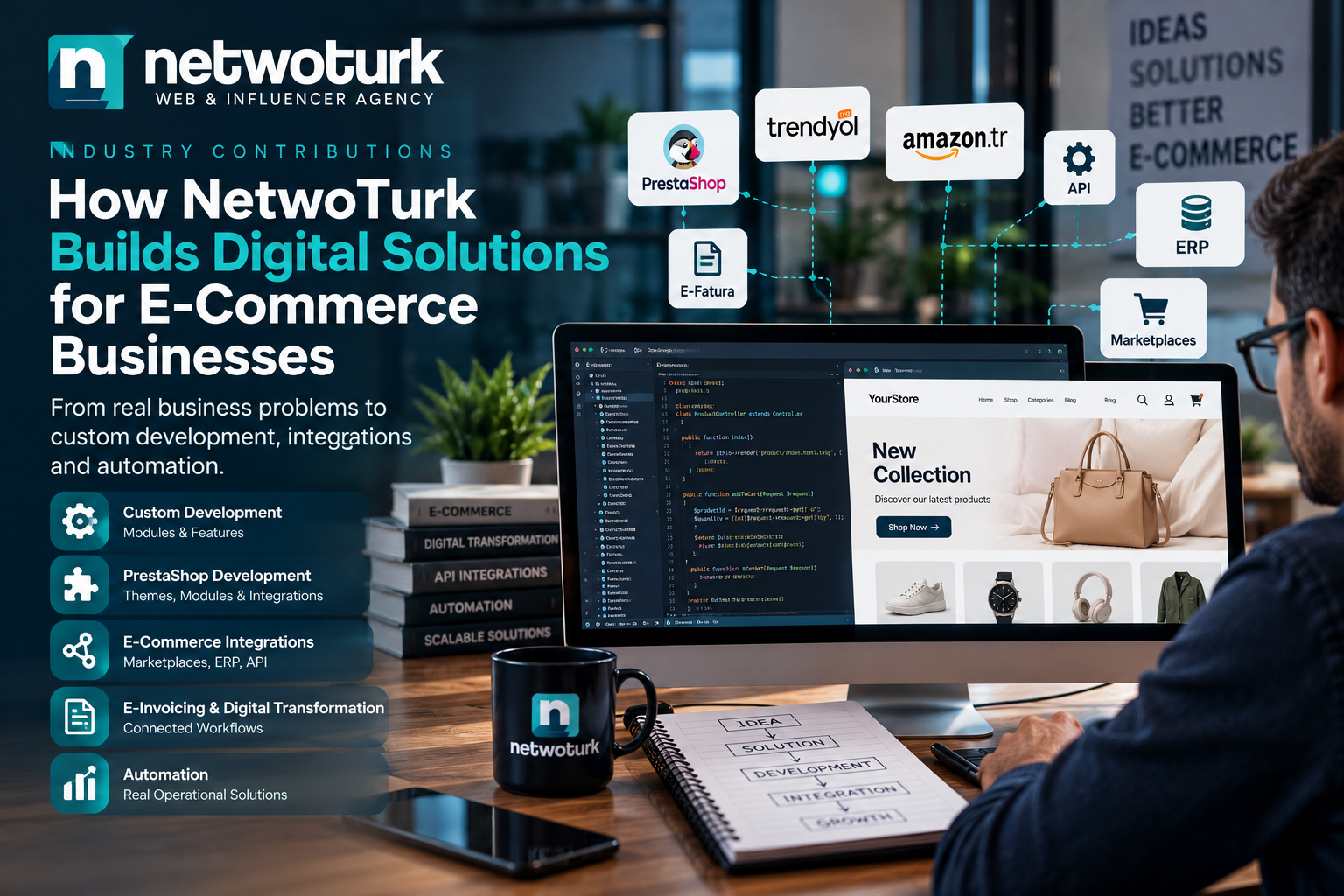 How NetwoTurk Builds Digital Solutions for E-Commerce BusinessesDaha Fazla
Discover how NetwoTurk approaches PrestaShop development, custom modules, e-commerce integrations, marketplace...
-
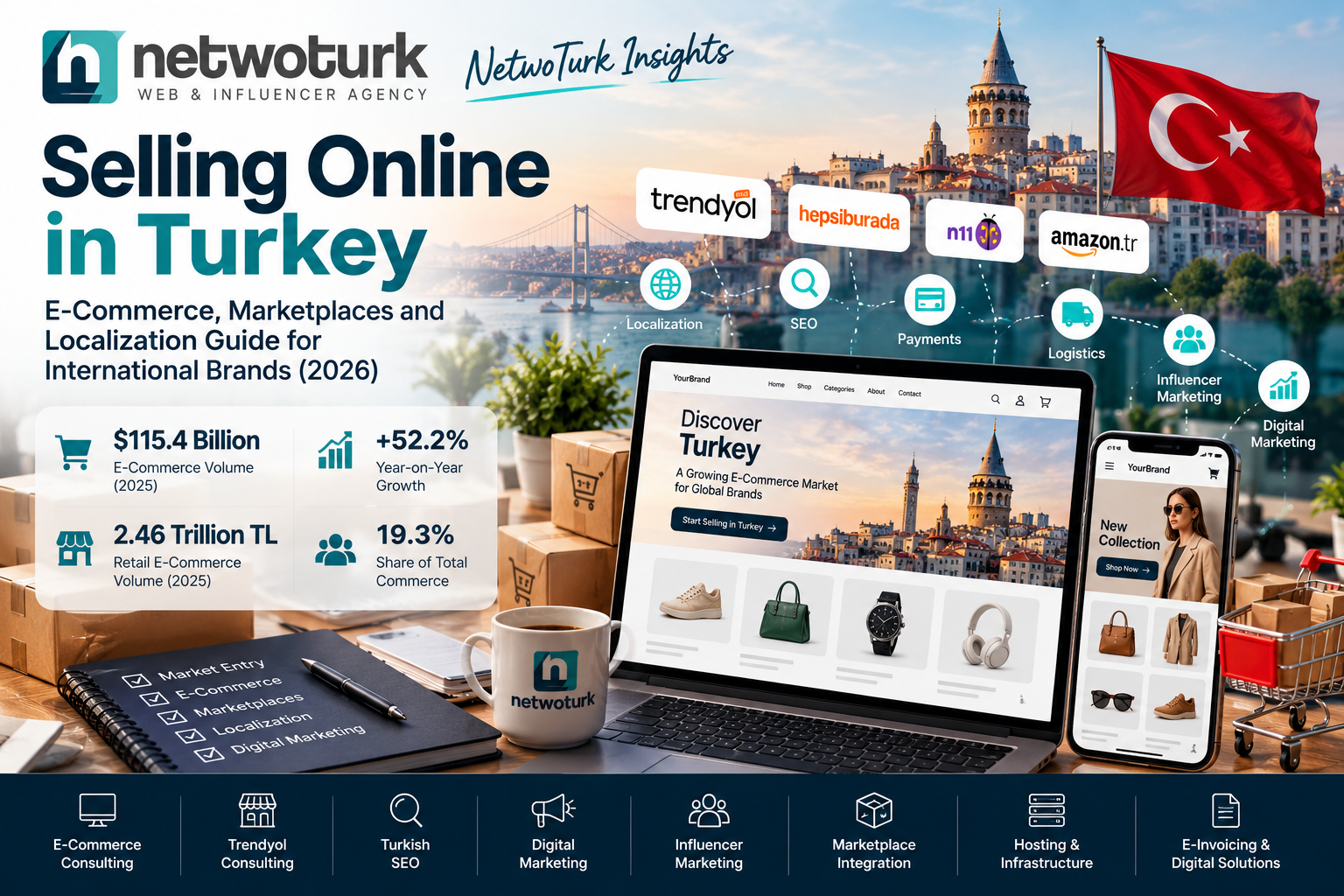 Selling Online in Turkey: E-Commerce, Marketplaces and Localization Guide for International Brands (2026)Daha Fazla
Turkey has become a significant e-commerce market for international brands looking to expand into a large, digitally...
-
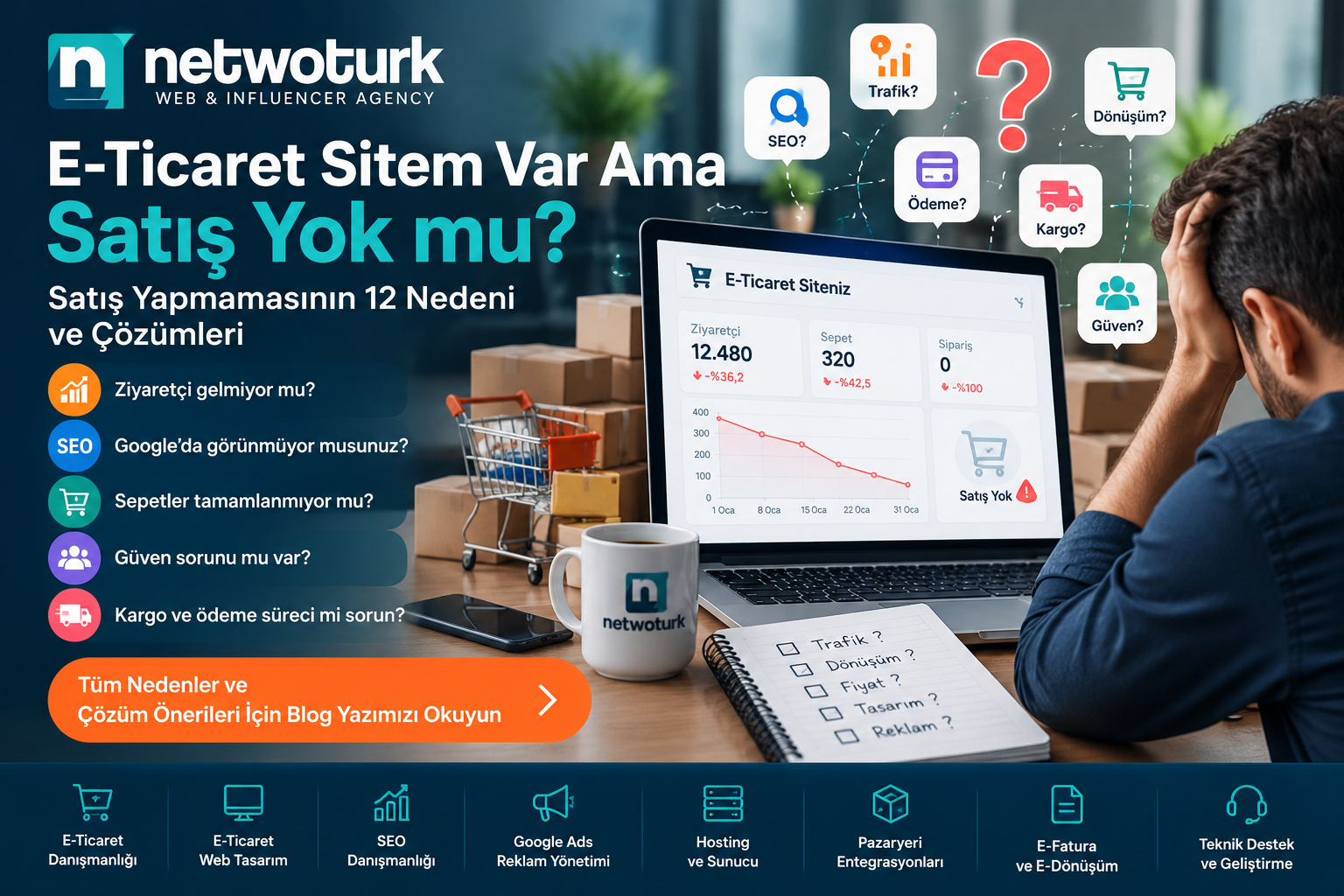 E-Ticaret Sitem Var Ama Satış Yok: Satış Yapmamasının 12 Nedeni ve ÇözümleriDaha Fazla
E-ticaret sitesinin satış yapmaması her zaman sitenin kötü olduğu anlamına gelmez. Sorun trafik, hedefleme, ürün,...
-
 E-Ticaret Danışmanlığı Nedir? İşletmeler Neden Profesyonel E-Ticaret Danışmanlığı Almalı? 2026 RehberiDaha Fazla
E-ticaret sitesi kurmak artık geçmişe göre çok daha kolay. Bir alan adı satın almak, hazır bir altyapı seçmek,...
-
 Influencer Marketing in Turkey: A Practical Guide for International Brands in 2026Daha Fazla
Turkey offers international brands a digitally active, mobile-first audience and a creator ecosystem capable of...
-
 Trendyol'da Satışlar Neden DüşerDaha Fazla
Trendyol satışlarınız neden düştü? Mağaza puanı, Buybox, ürün görünürlüğü, reklam, stok ve iade sorunlarını...
-
 PrestaShop 500 Internal Server Error Hatası Nasıl ÇözülürDaha Fazla
PrestaShop 500 Internal Server Error neden olur? PHP, modül, tema, override, hosting ve güncelleme kaynaklı 500...
-
 PrestaShop Uzmanı Ne Yapar? PrestaShop Destek, Kurulum ve Geliştirme Rehberi 2026Daha Fazla
PrestaShop uzmanı mı arıyorsunuz? PrestaShop teknik destek, hata çözümü, hızlandırma, modül ve tema geliştirme, SEO,...
-
 Yapay Zeka İle Web Sitesi Güvenli Mi?Daha Fazla
Yapay zekâ ile yapılan web siteleri güvenli mi? Riskleri, doğru güvenlik yaklaşımını ve NetwoTürk'ün insan denetimli...
Blog categories
Search in blog
Archived posts
How NetwoTurk Builds Digital Solutions for E-Commerce Businesses
The e-commerce industry does not need more technology simply for the sake of technology.
It needs solutions to real business problems.
A retailer may need to synchronize inventory across different sales channels. Another business may struggle with invoicing, marketplace operations or repetitive manual processes. An e-commerce company may have a platform that works well overall but lacks one critical feature required by its operation.
At NetwoTurk, this is where we believe digital development should begin:
Not with the software, but with the problem.
Our work across e-commerce, web technologies, digital transformation and custom development has increasingly led us toward building solutions designed around actual operational needs.
This approach has become an important part of how NetwoTurk contributes to the digital commerce ecosystem.
Technology Should Solve a Business Problem
It is easy to start a digital project by discussing technologies.
Which platform should we use?
Which module should we install?
Should we build an application?
Should we replace the existing system?
These questions matter, but they should not necessarily be the first questions.
We prefer to begin with something simpler:
What problem are we trying to solve?
Consider an e-commerce business that manually updates inventory across several systems.
The immediate request might be:
“We need new software.”
But the actual problem may be that the same information has to be entered repeatedly into different platforms.
In that case, replacing the entire e-commerce infrastructure may not be necessary.
An integration or a purpose-built automation could potentially solve the operational problem while preserving the systems that already work.
This distinction is important.
Digital transformation should not mean replacing technology unnecessarily.
It should mean improving how the business operates.
Working With Existing E-Commerce Infrastructure
One principle has become increasingly important in our development work:
If a system is working correctly, do not change it without a clear reason.
E-commerce environments can become complex.
A single store may include:
-
An e-commerce platform
-
A commercial theme
-
Custom modules
-
Payment integrations
-
Shipping integrations
-
Marketplace connections
-
ERP software
-
Accounting systems
-
E-invoicing
-
Analytics
-
Marketing technologies
-
Custom business processes
Changing one component without understanding its relationship with the others can create unexpected problems.
For this reason, our technical approach is generally based on understanding the existing architecture before making modifications.
The objective is not to rewrite everything.
The objective is to identify the smallest reliable change capable of solving the problem.
Why PrestaShop Has Become an Important Part of Our Development Work
PrestaShop is one of the platforms with which NetwoTurk has accumulated significant practical development experience.
Its open architecture allows businesses to extend an e-commerce operation through themes, modules, integrations and custom development.
That flexibility is valuable.
It also creates responsibility.
A modification that solves today's problem but damages compatibility with future updates may eventually become a larger problem than the one it originally solved.
For this reason, our approach to PrestaShop development emphasizes maintaining a clear separation between the platform's core functionality and business-specific development wherever technically appropriate.
Instead of immediately modifying core files, we first evaluate whether the requirement can be implemented through:
-
Modules
-
Hooks
-
Services
-
APIs
-
Configuration
-
Platform-supported extension mechanisms
This approach helps make custom functionality easier to maintain and understand.
Custom Modules Should Have a Clear Purpose
There are thousands of existing modules and extensions available for e-commerce platforms.
Building a custom module is therefore not automatically the best solution.
Before custom development, we ask:
Does a reliable solution already exist?
Is it compatible with the current platform?
Can it meet the business requirement without unnecessary complexity?
Will it remain maintainable?
If the answer is yes, using an existing solution may be more efficient.
Custom development becomes valuable when the business has a requirement that existing products cannot adequately address.
Examples can include:
-
Specialized business workflows
-
Custom marketplace processes
-
Internal management systems
-
Unique pricing structures
-
Custom reporting
-
Operational automation
-
Customer-specific functionality
-
Integration between previously disconnected systems
The purpose of custom software should not be to make a project appear more sophisticated.
It should remove a real limitation.
Building Around Real Operational Workflows
Some of the most useful software ideas do not begin in a development meeting.
They begin during daily operations.
A team may say:
“We enter this information twice.”
“We manually check this every morning.”
“We export this file and then enter the same information into another system.”
“We cannot see all of these records in one place.”
“This process takes several hours every week.”
Statements like these are valuable.
They identify processes that may be candidates for automation.
Our development approach increasingly focuses on mapping these workflows before deciding what should be built.
A typical process can be considered as:
Current Process → Bottleneck → Required Data → Automation Opportunity → Technical Solution → Testing → Measurement
This allows development to remain connected to the actual operation.
E-Commerce Integration Is Often More Valuable Than Another Dashboard
Modern businesses already use many dashboards.
The problem is often not the absence of another interface.
It is that existing systems cannot communicate effectively.
For example, a company may use separate systems for:
-
Website orders
-
Marketplace orders
-
Inventory
-
Invoicing
-
Accounting
-
Shipping
-
Customer management
If each system requires independent manual work, growth can increase administrative workload almost as quickly as it increases revenue.
Integration attempts to solve this problem by allowing appropriate information to move between systems.
Depending on the project, this can include:
-
Order synchronization
-
Inventory synchronization
-
Product data
-
Pricing
-
Invoice information
-
Customer information
-
Shipment status
-
Reporting data
However, automation must be designed carefully.
An incorrect automated process can create errors much faster than a manual process.
For that reason, validation, logging, error handling and controlled testing are important parts of integration development.
Digital Transformation Does Not Mean Automating Everything
Automation is powerful, but not every process needs automation.
If a task occurs once every few months and takes five minutes, developing a complex automation system may provide little business value.
If a task is performed hundreds of times every day and regularly creates errors, automation may produce substantial value.
We therefore evaluate automation through questions such as:
-
How often is the process performed?
-
How much employee time does it consume?
-
How frequently do errors occur?
-
What is the financial impact of those errors?
-
Can the process be standardized?
-
What happens if the automation fails?
-
Can a human intervene when necessary?
The objective is not maximum automation.
The objective is useful automation.
E-Invoicing as Part of the E-Commerce Workflow
In many e-commerce operations, the customer journey does not end when an order is placed.
The business still needs to manage:
-
Payment
-
Inventory
-
Fulfilment
-
Shipping
-
Invoicing
-
Accounting
-
Returns
When these systems operate independently, employees may need to transfer information manually.
This is why we view e-invoicing and digital transformation as part of the broader e-commerce architecture rather than an isolated administrative process.
NetwoTurk works across e-commerce and digital transformation services, including solutions related to e-invoicing and associated digital business processes.
Where technically and operationally appropriate, these systems can become part of a connected workflow rather than separate islands of information.
Marketplaces Create New Integration Challenges
Selling through multiple channels creates opportunities, but it also creates operational complexity.
A business might simultaneously sell through:
-
Its own e-commerce website
-
Trendyol
-
Other marketplaces
-
Physical stores
-
Social commerce channels
The same product may therefore exist in several systems.
This creates important questions:
Which system owns the inventory?
What happens when the last item is sold?
Where should prices be updated?
How should orders reach the accounting system?
How are invoices created?
How are cancellations handled?
How are returns synchronized?
These are not simply technical questions.
They are business-process questions.
The technology should be designed after those rules are defined.
Why We Avoid Unnecessary Core Modifications
One of the lessons repeatedly reinforced through e-commerce development is that the fastest modification is not always the safest modification.
Editing a platform's core code can sometimes appear to solve a problem immediately.
However, future updates can overwrite those changes or introduce compatibility issues.
For platforms such as PrestaShop, we therefore prefer supported extension mechanisms wherever possible.
This makes the architecture easier to understand and reduces unnecessary dependencies on undocumented modifications.
There may still be exceptional cases requiring deeper intervention.
But such decisions should be deliberate, documented and technically justified.
Compatibility Matters More Than Features
A module can have an impressive feature list and still be unsuitable for a particular store.
Compatibility needs to be considered across the full environment.
This can include:
-
E-commerce platform version
-
PHP version
-
Database environment
-
Theme
-
Existing modules
-
Overrides
-
Server configuration
-
External APIs
This is particularly important in established e-commerce stores where years of development may already exist.
Installing another component without understanding the current environment can create conflicts.
For this reason, technical analysis should precede implementation.
Testing Is Part of Development
A feature is not complete simply because the code has been written.
It must work within the actual environment.
Depending on the project, testing may include:
-
Installation
-
Upgrade
-
Configuration
-
Front-office behavior
-
Back-office behavior
-
Database changes
-
Permissions
-
API communication
-
Error handling
-
Responsive interfaces
-
Existing store functionality
For commerce systems, critical workflows deserve additional attention.
These may include:
-
Product browsing
-
Customer login
-
Cart
-
Checkout
-
Payment
-
Order creation
-
Invoicing
-
Administration
A modification that fixes one screen but breaks checkout cannot be considered a successful fix.
Documentation Is an Engineering Tool
Documentation is sometimes treated as something to prepare after development.
We see it as part of the development process itself.
Useful documentation can record:
-
What was changed
-
Why it was changed
-
Required versions
-
Dependencies
-
Database changes
-
Configuration
-
Upgrade procedure
-
Known limitations
-
Rollback information
This becomes increasingly valuable as systems grow.
Months later, the developer investigating a problem may not be the person who originally created the feature.
Good documentation reduces that dependency.
Building Reusable Knowledge
Custom development also creates something beyond software:
Knowledge.
When the same operational problem appears across different businesses, lessons from one implementation can improve the next.
Patterns begin to emerge.
For example:
-
Which processes should remain manual?
-
Which data should be synchronized?
-
Where should validation occur?
-
What information should be logged?
-
How should updates be handled?
-
How should failures be communicated?
This accumulated knowledge is one of the reasons we created the Industry Contributions section of NetwoTurk Insights.
We want to document not only what technology exists, but also what we learn while applying technology to real business problems.
From Agency Services to Technology Development
NetwoTurk began from a service-oriented digital perspective, working across web technologies, e-commerce, digital marketing and related business services.
As customer requirements became more specialized, software development naturally became a larger part of that work.
A customer might initially request a website.
Later, the real requirement could involve:
-
A marketplace connection
-
An invoicing workflow
-
A custom management panel
-
A specialized PrestaShop module
-
An API integration
-
An operational automation
This progression changed how we think about digital agency work.
A modern digital partner may need to understand not only design and marketing, but also the technical systems behind the business.
Our Approach to Building Digital Solutions
Our development philosophy can be summarized in a relatively simple sequence:
1. Understand the business problem.
Do not begin with the technology.
2. Understand the existing system.
Identify what already works before replacing anything.
3. Research the platform and its supported architecture.
Development should respect the technology being extended.
4. Choose the smallest reliable solution.
More code does not automatically mean a better solution.
5. Keep custom development maintainable.
Avoid unnecessary dependencies and undocumented changes.
6. Test the complete workflow.
A local fix should not damage another part of the operation.
7. Measure the result.
The project should improve something meaningful for the business.
What Does Industry Contribution Mean to NetwoTurk?
We do not believe industry contribution is limited to publishing software as open source or releasing a new product.
Contribution can also mean sharing practical knowledge.
It can mean documenting a difficult technical problem.
It can mean explaining why a particular implementation failed.
It can mean creating a better workflow for a repetitive business process.
It can mean developing tools that allow smaller businesses to use technology that would otherwise require complex manual operations.
And it can mean sharing lessons learned from real projects so that the wider e-commerce community can make better technical decisions.
That is the purpose of this section.
What We Will Publish in Industry Contributions
Future NetwoTurk Industry Contributions articles will explore topics such as:
-
PrestaShop development practices
-
Custom module architecture
-
E-commerce integrations
-
Marketplace automation
-
E-invoicing workflows
-
API development
-
Digital transformation
-
Operational automation
-
Technical lessons from real projects
-
E-commerce infrastructure
-
AI-assisted business workflows
-
Software development decisions
Where possible, we will focus on practical problems rather than theoretical technology discussions.
Building Better Digital Commerce Through Practical Engineering
E-commerce technology continues to change rapidly.
New platforms, artificial intelligence systems, marketplaces, APIs and automation tools create new possibilities almost every year.
But the fundamental question remains unchanged:
Does this technology make the business work better?
That question guides our approach at NetwoTurk.
We believe effective digital development comes from combining business understanding with technical engineering.
Sometimes the right solution is a new system.
Sometimes it is an integration.
Sometimes it is a custom module.
And sometimes the best decision is to leave a working system exactly as it is.
The value is not in how much technology we add.
The value is in solving the right problem.
About NetwoTurk
NetwoTurk is a Turkey-based web, e-commerce and digital solutions agency working across web development, e-commerce technologies, custom software, digital transformation, SEO, hosting, marketplace operations and digital marketing.
Through NetwoTurk Industry Contributions, we share practical engineering knowledge, development experiences and lessons from the problems we encounter while building digital solutions for businesses.
Website: netwoturk.com
Frequently Asked Questions
What does NetwoTurk develop for e-commerce businesses?
Depending on business requirements, NetwoTurk works on e-commerce websites, PrestaShop development, custom modules, integrations, marketplace workflows, automation and digital transformation solutions.
Does every e-commerce business need custom software?
No. If an existing reliable solution satisfies the requirement, custom development may add unnecessary cost and complexity. Custom software is most valuable when it solves a requirement that existing systems cannot adequately address.
Why avoid modifying the core of an e-commerce platform?
Unnecessary core modifications can complicate maintenance and future upgrades. Where possible, supported extension mechanisms such as modules, hooks and APIs provide a more maintainable approach.
Can marketplace and e-commerce systems be integrated?
Depending on the platforms and available APIs, systems can potentially exchange information such as orders, inventory, products, prices and operational data.
What is the purpose of NetwoTurk Industry Contributions?
The section documents NetwoTurk's practical experience in e-commerce engineering, integrations, automation and digital transformation while sharing lessons that can be useful to the wider digital commerce ecosystem.
Behzat Boğazlıyanlıoğlu
Founder of NetwoTurk | E-Commerce & Digital Transformation Specialist
Posted in:
Industry Contributions
Leave a comment